Water leaks
How to find a water leak without unnecessary demolition
Start with the leak history and staged testing rather than opening finishes at the first damp patch. Water can travel along slabs, cavities, pipes and framing, so the visible stain may be well away from the fault. Testing helps narrow the repair scope, but concealed areas may still need agreed access.
DAC Investigative Reporting
What information helps locate a leak?
Record the affected area, when the water appears and whether it follows rain, a shower, a fixture being used or another event. Photographs, previous repair details and changes over time give the investigation a useful starting point.
A leak investigation also considers condensation and drainage. More than one issue may be present, so an apparent connection with one fixture does not by itself confirm the cause.
Which tests may be used?
The tests are selected for the property, suspected system and available access. Not every investigation needs every method.
- Supply-pipe pressure testing to investigate plumbing faults.
- Controlled flow tests of wastes, drains and fixtures.
- Isolated spray, flood or dye tests where appropriate.
- Moisture mapping and direct readings, with thermal imaging where useful.
- Humidity, airflow and condensation checks.
- Zone-by-zone testing while monitoring adjoining areas.
Can thermal imaging prove where the leak starts?
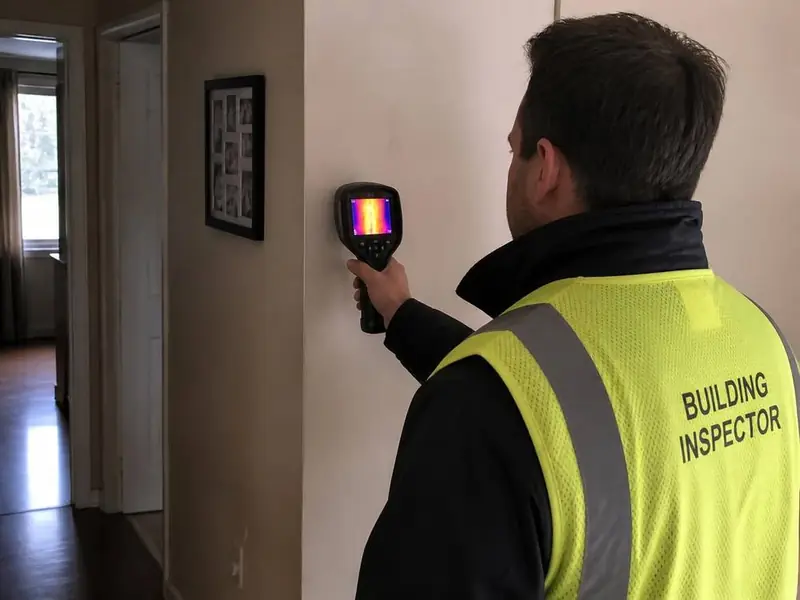
Thermal imaging helps identify patterns worth investigating. It forms part of a wider assessment with moisture readings, visual observations and controlled tests. A pattern alone should not become a repair scope without considering the other evidence.
Can testing avoid opening a wall?
Staged testing can reduce unnecessary disturbance by separating likely sources and narrowing the affected area. It cannot guarantee that finishes will remain intact. A small access point may be needed when the source or condition stays concealed.
The findings should explain what was confirmed, what remains uncertain and why further access or a specialist test is recommended.
What should happen after the source is identified?
The report records the tests, whether water entry was reproduced, the source supported by the results and the inspection limits. Repair, drying and reinstatement can then be scoped around those findings.
Post-repair testing checks the result. Treating the stain alone, without resolving the water source, does not establish that the leak has been repaired.